IEEE ComSoc Distinguished Lecture by Dr. Fatima Hussain at UET Lahore
The IEEE Communications Society (ComSoc) Distinguished Lecture by Prof. Dr. Fatima Hussain was successfully organized on Thursday, 23 October 2025, at the KICS Seminar Hall, University of Engineering and Technology (UET) Lahore. The event brought together faculty members, students, researchers, and industry professionals to explore the emerging landscape of cybersecurity and artificial intelligence. The session was part of Dr. Fatima’s Pakistan-wide Distinguished Lecturer Program (DLP) tour, which included stops at NUST Islamabad, UET Lahore, The University of Faisalabad, and Islamia University Bahawalpur.
Guests began arriving around 11:00 AM, half an hour before the official start of the event. They were warmly welcomed by Mr. Kashif Bashir, Chair IEEE ComSoc Lahore Chapter, along with his organizing team from KICS. The welcoming desk was efficiently managed, and guests were guided toward the seminar hall where refreshments were served. Faculty members from various departments, along with students from Computer Science, Electrical Engineering, and Artificial Intelligence programs, gathered in anticipation of meeting one of the world’s leading cybersecurity experts. The overall atmosphere was vibrant, professional, and filled with academic enthusiasm.
The program officially commenced at 11:30 AM with the Recitation of the Holy Quran, beautifully delivered by Dr. Yasir Saleem, Chairman of the Department of Computer Engineering at UET Lahore and Chair IEEE Lahore Section. This was followed by the National Anthem of Pakistan, performed with full zeal by the attendees, symbolizing national pride and unity.
Following the anthem, Mr. Kashif Bashir took the stage to deliver his welcome address. He began with a heartfelt “Assalam-o-Alaikum” and extended a very warm welcome to all guests, teachers, students, and participants. He expressed profound gratitude to IEEE ComSoc USA for approving this Distinguished Lecture and providing USD 2,300 in support for Dr. Fatima Hussain’s travel across Pakistan. Mr. Bashir shared that Dr. Fatima’s lecture series would cover four prestigious institutions, each contributing to academic collaboration and research in cybersecurity.
He then introduced the day’s session titled “Emerging Cyber Security Threats and Current State of Art”, co-organized by KICS UET Lahore, in collaboration with the Office of Research, Innovation and Commercialization (ORIC), the Department of Computer Science and Engineering, the Quality Enhancement Cell (QEC), and the Faculty & Staff Development Program at UET.
During his address, Mr. Bashir briefly discussed the history and mission of IEEE and its Communications Society. He explained that IEEE is the world’s largest community of engineers and technologists, with over 4.8 million members and 330 local sections worldwide. He highlighted the vital role of IEEE in Pakistan, which began in Lahore in 1968, and has since expanded into Karachi and Islamabad Sections, with Bahawalpur and Faisalabad as sub-sections.
Mr. Bashir then elaborated on the IEEE Communications Society (ComSoc), founded in 1952 and recognized globally since 1972. He noted its presence in 149 countries with 30,000 members, emphasizing its leadership in information and communication technologies. He also mentioned ComSoc’s flagship global conferences—IEEE GLOBECOM and IEEE ICC—which inspire innovation and global collaboration.
Before concluding, Mr. Bashir played a special video message from Prof. Dr. Anna Garcia Armada, Vice President of Global Services at IEEE ComSoc, who sent her greetings and appreciation for Pakistan’s active participation in the DLP program. Mr. Bashir then announced a 25% discount on IEEE Student Membership, encouraging students to join IEEE and ComSoc for just PKR 3,000, emphasizing the career and research benefits of IEEE membership. His address concluded with an invitation to welcome Dr. Fatima Hussain to the podium.

Following the welcome remarks, Dr. Yasir Saleem, Chair IEEE Lahore Section, Vice Chair IEEE ComSoc Lahore Chapter, and Chair IEEE Computer Society Lahore Chapter, addressed the audience. He began by appreciating the efforts of the IEEE ComSoc Lahore Chapter and KICS UET Lahore for organizing such a high-impact technical session under the prestigious Distinguished Lecturer Program. Dr. Yasir emphasized that the IEEE Lahore Section has always prioritized activities that bridge academia and industry, bringing global experts to Pakistan to inspire young engineers and researchers. He spoke about the growing importance of cybersecurity and AI-driven communication systems, calling them the backbone of future digital infrastructure. Dr. Yasir highlighted how IEEE’s mission—to advance technology for humanity—is reflected in such collaborative events, where international experts like Dr. Fatima Hussain share insights that shape both policy and practice. He encouraged students to actively participate in IEEE technical societies and make use of the vast global network of learning, mentorship, and innovation. Concluding his remarks, Dr. Yasir reaffirmed IEEE Lahore Section’s commitment to supporting academic excellence and nurturing the next generation of cybersecurity professionals in Pakistan.
Dr. Fatima Hussain, a globally recognized cybersecurity researcher, Principal SaaS Security Architect at the Royal Bank of Canada (RBC), and Distinguished Research Fellow at National CERT Pakistan, delivered a one-hour interactive session on Emerging Cyber Security Threats and the Current State of the Art.
The highlight of the event was the Distinguished Lecture delivered by Prof. Dr. Fatima Hussain, IEEE ComSoc Distinguished Lecturer and Principal SaaS Security Architect at the Royal Bank of Canada (RBC). Her talk, titled “Emerging Cyber Security Threats and Current State of Art,” provided an exceptionally comprehensive overview of the global cybersecurity landscape and its implications for academia, industry, and public policy. The session was not only informative but also deeply thought-provoking, offering both theoretical understanding and practical perspectives drawn from her rich experience in the financial and enterprise security sectors of North America.
Dr. Fatima began her presentation by painting a vivid picture of the rapidly evolving threat landscape that characterizes the digital era. She explained how digital transformation, virtualization, and the global shift to cloud-based services and SaaS architectures have revolutionized business operations—while simultaneously creating new vulnerabilities. She described cybersecurity as a “dynamic battlefield” where defenders and attackers are in a constant race of innovation. Citing real-world examples, she demonstrated how organizations today must manage risks not just from external actors but also from insider threats, data breaches, and third-party integrations that expose sensitive infrastructure to unforeseen vulnerabilities.

Moving deeper into the discussion, Dr. Fatima addressed the rise of Generative AI (GenAI) and its double-edged nature. She explained that while AI-driven tools can automate threat detection and enable predictive defense mechanisms, they can also be exploited to generate sophisticated phishing attacks, deepfakes, and adversarial payloads capable of evading conventional security systems. This part of her lecture captivated the audience, as she showcased how AI can be used both as a shield and a weapon in cyberspace.
Dr. Fatima elaborated on modern defense strategies that leverage artificial intelligence and machine learning to enhance enterprise resilience. She discussed how AI-enabled risk profiling systems, behavioral analytics, and anomaly detection frameworks are transforming the way large organizations monitor their digital ecosystems. Drawing from her experience at RBC, she presented case studies on implementing insider threat prevention models and compliance scoring systems, emphasizing the importance of proactive security posture management.
Her presentation also touched on AI governance, ethical frameworks, and data privacy laws, explaining how the responsible deployment of AI in cybersecurity requires a balance between innovation and accountability. She spoke about the growing global consensus around regulatory alignment, especially as countries develop data protection laws inspired by GDPR and other international standards. Her insights were particularly relevant to Pakistani researchers and policymakers exploring pathways to strengthen national cyber resilience and AI ethics frameworks.
Throughout the one-hour session, the audience—comprising UET faculty members, postgraduate researchers, and undergraduate students—remained fully engaged. Many participants took notes diligently and posed thought-provoking questions related to real-world cyber incidents, zero-trust architecture, digital identity, and privacy-preserving AI. Dr. Fatima’s ability to respond with clarity and practical wisdom impressed everyone in attendance. Her interactive style, which encouraged open dialogue, created an environment that felt less like a lecture and more like a collaborative knowledge exchange.
As the session drew to a close, Dr. Fatima shifted focus to the future of international research collaboration. She introduced the audience to Canada’s Mitacs Research and Innovation Program, which supports international students and faculty in pursuing collaborative research in cybersecurity, artificial intelligence, and cloud systems. She encouraged Pakistani students to apply for such opportunities, highlighting how exposure to global research environments can significantly enhance technical competence and cross-cultural understanding.
One of the most pivotal moments of the IEEE ComSoc Distinguished Lecture event at UET Lahore was the MoU signing ceremony, held immediately after Dr. Fatima Hussain’s lecture. This brief yet profoundly symbolic activity represented a new era of inter-university collaboration in the domain of cybersecurity, artificial intelligence, and communication technologies across Pakistan.
In this ceremony, Dr. Fatima Hussain, serving as an IEEE ComSoc Distinguished Lecturer and Principal SaaS Security Architect at the Royal Bank of Canada (RBC), formalized General Purpose Memoranda of Understanding with several leading universities of Lahore. The signatories included some of the most respected academic leaders in Pakistan’s higher education landscape:
- Dr. Kamran Abid, Dean of Electrical Engineering, University of the Punjab
- Dr. Mehtab Afzal, Dean of Computer Science, The University of Lahore
- Dr. Farooq Ahmad, Dean of Computer Science, COMSATS University Lahore Campus
- Dr. Atif Alvi, Dean of Computer Science, University of Management and Technology (UMT)
- Dr. Tahir Ilyas, Director ORIC, Lahore Garrison University (LGU)
- Dr. Yasir Saleem, representing the Department of Computer Engineering, UET Lahore
Each of these MoUs aims to establish a long-term academic and research partnership focusing on collaborative projects, joint supervision of graduate research, faculty exchange programs, and industry-driven innovation in cybersecurity and AI governance. The agreements are designed not merely as ceremonial gestures but as living documents that enable knowledge exchange between Canadian and Pakistani institutions through the active involvement of Dr. Fatima Hussain and IEEE ComSoc.
Through these MoUs, the partner universities have agreed to engage in joint seminars, training programs, and hackathons that will directly benefit students by exposing them to international standards in research methodology, cloud computing, SaaS security architecture, and risk modeling. Moreover, these collaborations open doors for capacity-building initiatives, where faculty members from Pakistani universities can co-author research papers with global experts, seek international funding opportunities, and integrate cutting-edge cybersecurity concepts into their curricula.
The significance of this initiative extends far beyond institutional collaboration—it represents a strategic national step toward strengthening Pakistan’s cybersecurity education ecosystem. The rapid digital transformation across Pakistan demands a technically skilled workforce capable of addressing emerging threats in AI-enabled environments. By connecting universities through a shared academic and research agenda, these MoUs set the foundation for what could become Pakistan’s first inter-university Cybersecurity and AI Research Alliance, under the intellectual mentorship of Dr. Fatima Hussain and IEEE ComSoc’s global network.
Furthermore, these agreements complement Pakistan’s broader vision under the Digital Pakistan Initiative, emphasizing secure digital transformation, ethical AI adoption, and industry-academia partnerships. The participating institutions will not only share research resources but also promote student mobility, enabling learners to participate in workshops and joint projects hosted at partner campuses. This inclusive approach helps reduce institutional isolation and encourages innovation through cross-disciplinary collaboration.
Dr. Kamran Abid, Dean of Electrical Engineering at the University of the Punjab, was the first to speak. He began by expressing deep appreciation to IEEE ComSoc Lahore Chapter and KICS UET Lahore for initiating a collaborative framework that connects leading universities under a single academic vision. Dr. Kamran emphasized that the University of the Punjab, being one of the oldest and most respected academic institutions in Pakistan, places strong emphasis on interdisciplinary collaboration and applied research. He noted that cybersecurity has now become a critical national concern, intersecting with almost every domain of engineering and computing. By signing the MoU, he said, these universities have not only formalized cooperation but have also set a precedent for academic solidarity in addressing Pakistan’s most pressing digital challenges. Dr. Kamran also highlighted the importance of joint graduate research, faculty development, and international linkages, affirming Punjab University’s readiness to play an active role in upcoming collaborative projects led by IEEE and Dr. Fatima Hussain.
Next, Dr. Mehtab Afzal, Dean of Computer Science at The University of Lahore (UOL), shared his reflections. He praised the initiative as a transformative step toward unifying academic efforts across Lahore’s top institutions. Dr. Mehtab highlighted how cybersecurity and AI are rapidly shaping the global digital economy, and that Pakistan must prepare its youth to contribute to this domain through skill-based education and international exposure. He commended Dr. Fatima Hussain for her inspiring lecture and for taking the lead in connecting Pakistani universities with global research networks. Dr. Mehtab elaborated that The University of Lahore has been actively encouraging cross-campus collaboration, and this MoU will further accelerate joint research publications, industry-based projects, and curriculum innovation. He also proposed forming a joint academic working group under IEEE ComSoc Lahore Chapter to ensure continuous follow-up and project alignment among all partner universities.
Dr. Farooq Ahmad, Dean of Computer Science at COMSATS University Lahore Campus, spoke next. He described the MoU initiative as a landmark in Pakistan’s academic collaboration history, symbolizing unity in purpose among institutions that traditionally operate independently. Dr. Farooq emphasized that COMSATS Lahore has long prioritized research commercialization, cyber defense innovation, and international linkages, and this agreement provides a practical avenue to deepen these priorities. He discussed how COMSATS is already leading projects in AI-based network security, data protection, and cyber forensics, and how a shared platform among universities could multiply these efforts through shared datasets, research grants, and student exchange programs. He also stressed the need to create joint postgraduate supervision frameworks, allowing Ph.D. and M.S. students from one university to collaborate with faculty from another, thereby enriching their research experience. Dr. Farooq concluded by thanking Dr. Fatima Hussain for her global mentorship and expressing confidence that her continued involvement would elevate Pakistan’s research visibility worldwide.
Finally, Dr. Atif Alvi, Dean of Computer Science at the University of Management and Technology (UMT), offered his insightful perspective. Dr. Atif began by acknowledging the visionary leadership of IEEE ComSoc Lahore Chapter for orchestrating a collaboration that bridges public and private sector universities under a unified goal of technological advancement. He described the signing of these MoUs as not just an academic formality, but as the beginning of a long-term partnership aimed at transforming research culture across Pakistan. Dr. Atif stressed that cybersecurity today is not only about protection—it’s about resilience, innovation, and global competitiveness. He remarked that Pakistan’s academic community must play a central role in shaping national cybersecurity frameworks and producing policy-relevant research. He proposed leveraging this network to organize joint national-level cybersecurity competitions, training camps, and innovation challenges, supported by IEEE ComSoc and industry partners. He also highlighted UMT’s readiness to host future collaborative workshops and contribute to joint funding proposals under national and international research grants.
In her remarks following the signing, Dr. Fatima Hussain expressed her deep appreciation for the commitment shown by the partner universities and reiterated her belief that Pakistan has immense untapped potential in cybersecurity research and innovation. She noted that the IEEE ComSoc Lahore Chapter and UET Lahore’s Al-Khawarizmi Institute of Computer Science (KICS) have played a leading role in fostering international linkages that can uplift the research capacity of Pakistani institutions.
The collective signing of these MoUs also serves as an inspiring example of academic diplomacy—where technology, education, and collaboration intersect to empower future generations. It symbolizes Pakistan’s growing participation in the global cybersecurity conversation, driven by partnerships that are intellectually robust, technologically forward, and globally connected.
After the signing of the MoUs, the session entered its final but intellectually enriching phase, where key academic leaders of UET Lahore shared their reflections on the day’s proceedings. Dr. Aneela Anwar, Director of the Faculty and Staff Development Program (FSDP) at UET Lahore, took the stage first. With her characteristic warmth and eloquence, she expressed her deep appreciation for the collaborative spirit that the IEEE ComSoc Distinguished Lecture embodied. Dr. Aneela emphasized that such high-impact academic events play a vital role in enhancing faculty capacity, professional development, and student engagement.
She pointed out that continuous faculty learning through global exposure and interaction with international experts like Dr. Fatima Hussain is essential to keeping the teaching community abreast of the latest research trends. She praised Dr. Fatima’s ability to translate complex cybersecurity topics into understandable concepts for students and educators alike, bridging the gap between theory and practice. Dr. Aneela expressed heartfelt gratitude to Dr. Fatima for traveling from Canada to Pakistan, dedicating her time and energy to strengthen Pakistan’s academic ecosystem. She also commended the efforts of the IEEE ComSoc Lahore Chapter and KICS UET for consistently organizing international-level seminars that elevate the learning environment at UET. According to her, such collaborations exemplify how knowledge sharing and international academic engagement can inspire innovation and collective growth.
Following her remarks, Prof. Dr. Amer Aziz, Director of the Quality Enhancement Cell (QEC) at UET Lahore, addressed the audience. He focused on how quality assurance mechanisms in higher education have evolved through the integration of technology and data-driven systems. Dr. Amer underscored that events like the IEEE Distinguished Lecture serve as benchmarks for academic excellence, offering exposure to emerging technologies and pedagogical advancements. He elaborated that QEC’s mission goes beyond compliance—it aims to embed a culture of continuous improvement within every department.
He acknowledged that bringing global experts like Dr. Fatima into the academic dialogue allows universities to re-evaluate their teaching methodologies and research outcomes against international standards. Dr. Amer noted that UET’s engagement with IEEE and ComSoc is a shining example of how external academic partnerships can reinforce institutional quality objectives. He encouraged faculty members to integrate insights from Dr. Fatima’s lecture into their classroom discussions, curriculum updates, and project-based learning models, ensuring that quality improvement translates into practical student benefits.
In his closing remarks, Mr. Kashif Bashir thanked all distinguished guests, speakers, and organizers for making the event successful. He announced that Dr. Fatima’s next DLP sessions would be held at The University of Faisalabad and Islamia University Bahawalpur, continuing her mission to raise cybersecurity awareness across Pakistan.
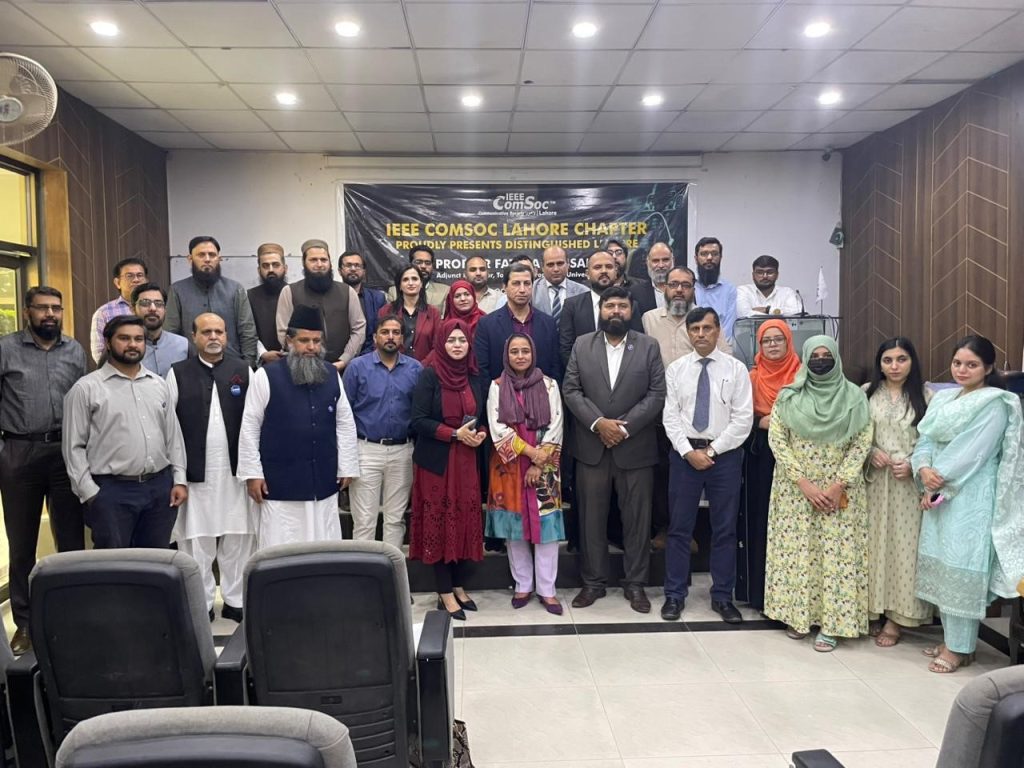
The event concluded with the presentation of shields and certificates of appreciation to the distinguished guests and organizing team. Participants, including students and faculty, received participation certificates, and the session ended with a group photo capturing the memorable collaboration. A lunch was served to all guests and faculty members, allowing further networking and discussion in a relaxed atmosphere.
Overall, the IEEE ComSoc Distinguished Lecture at UET Lahore was a resounding success, reflecting the strong academic spirit of the university, the leadership of IEEE ComSoc Lahore Chapter, and the inspiring contribution of Dr. Fatima Hussain toward shaping Pakistan’s cybersecurity future.
Posted on: November 13, 2025 Muzammil Hassan